Getting a Job
1
How to Find a Job
Finding a job is easier than you may think. A good way to start is by researching and making a list of all available jobs by using job search websites, newspapers, and family and friends advice. You will need to know the skills that you possess to make links between yourself and the available jobs, to know what types of work suit you the most.
Below are some tips to assist you in the job search:
- Different types of jobs eg: Entry –Level (apprenticeship & traineeships included), Regular jobs (casual, part-time & full-time positions)
- Skills: Problem solving skills, Communications skills, Organisation skills and Writing Skills, think about what sort of skills you have that can relate to the job you are applying for.
- When looking for work Keep a Diary: so you know what jobs you have applied for, appointment times, phone numbers etc.
- Search the Internet & Newspapers: Australian Job Search Website, Career One, Seek, My career, Acclaim and CRGT
- Register with Centrelink: as you may be entitled to payments and a quick referral to a Job Service Provider
- Join a Job Service Provider
- Family and Friends are good resources – Ask if they know of any positions available where they work?
- Direct Approach: this shows keenness, good communications skills, be positive, and sell your self with the skills you possess. Make sure you leave a copy of your resume and contact details.
- Notice Boards: inside Shopping Centres, Retail stores, TAFE and other Community Organisations often display jobs available.
- Wage Assistance card: $4400 for 6 months employment – Fulltime, $2200 for 6 months employment – Part time (min of 15 hours per week). You will need to register at Centrelink that you’re looking for work.
- Contacting employers: Before you call make sure you have a think about what sort of questions you want to ask and write them down. Make sure you speak clearly and keep the conversation to the point. Check the closing date of all open positions.
- Applications and letters: Ensure your letter of application is clean and neat – no spelling mistakes, no dirty marks or white out on the letter or resume. Have all your correct details on the cover letter and resume.
- References: Have at least 2 referees with correct contact details. And always ask this person if you can use them for a reference and advise them when you had the interview so they will be prepared when the employer calls them.
- The interview: Confirm the date, time and who you need to speak with, Do a dummy run to see how long it takes you to get there, better to be over dressed than under dressed, Think about questions and answers, Arrive 10 min before interview time.
- When starting work: Confirm your start time and date, take all your documents with you – tax file number, bank details & super details etc. Have suitable dress attire and use deodorants, perfume etc (but don’t over kill with it)
- Induction and rules: Find out where staff handbooks are kept or who can you get a copy of the rules and regulations of the workplace. Ensure you know where your roster is kept incase you misplace or lose your copy.
- When you get the job: Get to work on time, Ring your Manager or Supervisor if you are running late or sick, Don’t be frightened to ask questions, Listen to what you are asked to do, Keep yourself busy, Listen to feedback, Talk to your supervisor if you have
2
Application Process
Now that you have found a job, the next step is to apply for it. When applying for a job, you need to write a resume and, if requested, a cover letter. Below is a guide for writing a resume:
Writing a Resume
Before you begin writing your resumes, it is worth looking online for sample resumes and what to include. There are many ways to write a resume, and below are the main elements to include.
THE MAIN ELEMENTS OF A RESUME
- Your name, address and contact detailsIt is advised you write these details at the top of the page so potential employers can easily see it.
- EducationYour education is listed here and you will need to include your school details, your grade and if you wish, you can also add in the subjects you are currently studying.
- History of employment (if any)Here you list any previous employment that you may have, and include the start and end date of employment, position, company details and any activities you undertook during the employment period.
- Skills and QualificationsHere you create a list of skills and qualities that employers pay attention to when selecting candidates. A few examples of skills and qualities are:
- Qualities: Leadership, initiative, attitude, enthusiasm, determination, values and adaptability.
- Skills: Communication skills, organisational skills, teamwork skills and problem solving skills.
What a Potential Employer looks for:
- Positive Attitude
- Enthusiasm
- Neat appearance and well groomed
- Willingness to learn
- Punctuality and reliability
- Confidence
- Ability to convince them that you are the right person for the job!
- Sporting achievements/Community work
If you have be involved in any sporting groups or community work then it is important to include it in your resume. This shows employers that you have committed to a group or project and have taken up your own time to achieve something. - Activities/HobbiesAny activities that you have taken part in e.g. your school musical or band and any hobbies outside of school e.g. dance can be listed here as some employers may be interested in learning about your ability to commit to an activity.
- RefereesReferees are people that employers can contact who can give a reference regarding you and your abilities. You can add personal, academic or professional referees. A personal referee can be a family friend who knows you well, an academic referee can be a teacher or trainer, and a professional referee is a previous employer. Job applications will usually ask for a minimum of two (2) referees. Remember to ask your referees if you can use them before writing them down, and ensure that you get the contact information correct.
Once you have written your resume: Re-read it a few times to ensure there are no spelling or grammatical errors. Make sure that you only include relevant information. A resumes should not be very long, it needs to be precise and to the point. Lastly, keep updating your resume to ensure that all information is current and accurate.
3
Interview Process
Now that you have applied for a job, you will hopefully be called in for an interview. This step will outline the interview process, body language and how to dress to impress.
During the Interview
- Turn your mobile phone off
- Be aware of your body language and eye contact
- Do some research before your interview on the Company
- Ask questions
- Be alert and attentive
The main thing employers want is for you to be yourself! Be honest and genuine and it will impress your potential employer.
Body Language
Body language is a form of non-verbal communication and is the most noticed form. During an interview you should open your shoulders, keep your head up and don’t fidget or fiddle. By opening your body up you are communicating a professional and open attitude.
Dress to Impress
Ensure that you are dressed according to the role you are applying for. For Example, business-casual wear would be suitable when applying for a job as a chef at a restaurant.
What does the Employer want to know?
During your interview, your potential employer wants to know these things:
- Do you possess the skills, knowledge and qualities to perform the job?
- How well will you fit into their work environment?
- Are you motivated and hard working?
- Do you have potential for growth and development within the company?
- Do you have a positive and can do attitude?
Securing the Job
This is a guide to assist you in your professional development. Getting a job is the easy part, its securing it and moving up that’s the hardest. Here are a few simple tips for you to keep your job, and succeed:
- Be punctual and reliable
- Understand that you are not going to be the boss after one day!
- Ask questions
- Show common sense and initiative
- Be professional – respect other team mates and Supervisors
Below is a school to work transition diagram to show you the changes that will occur when transitioning from your schooling environment to a work environment.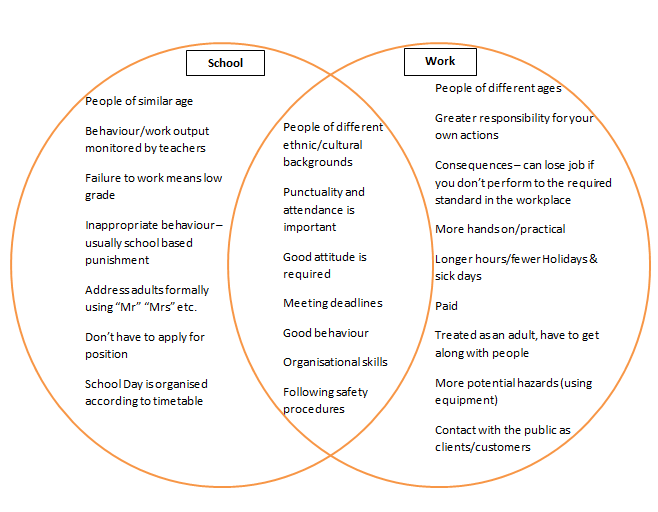
Effective Workplace Communication
It is important to understand how to effectively communicate in the workplace, as the relationships that you build may have an impact on your future career pathways. In order to be an effective communicator, you need to learn how to get your point across clearly, this involves being assertive, rather than passive or aggressive. An assertive communicator is someone who is able to voice an opinion whilst remaining respectful of others. A passive communicator is someone who does not voice their opinion, they instead, put others opinions before their own. Finally, an aggressive communicator is someone who voices their opinion and forces it upon others in an aggressive manner.
Being an assertive communicator when something upsets you in the workplace:
- Identify and assess the situation
- Communicate your opinion
- Discuss how it made you feel
- Look at an alternative solution
Being an assertive listener:
Communication is not a one way process. It involves a sender and a receiver. Sometimes you will be the sender, where you are discussing a topic with colleagues, and other times, you will be a receiver, where you listen to someone else. It is important to show people that you are listening by nodding, asking questions and repeating part of the message back to show the sender that you understood the message.
Teamwork
When you join the workforce, you will, at times, be apart of a team. Being a part of a team can be a very rewarding process which helps you learn new skills and reflect on yourself. Working within a diverse team can be challenging at times especially when no one can seem to agree upon a decision, but this can actually be a good thing. A common dysfunction that occurs when working in a team is called group think. Group think occurs when everyone in the team agrees upon decisions just to avoid conflict. This can result in a poorly thought out decision, and failure of the project you are working on. Conflict in this sense is something to be valued, as when everyone is constantly questioning and changing the decision, an effective outcome can be achieved.
Reflection
The most important part of any experience is reflection. Reflection occurs when you evaluate an experience by identifying the following questions:
- What happened?
- How did it make you feel?
- Was there anything you would like to do or not do again?
- What are some alternative solutions?
- What are the main points to take away?
Reflection helps you to look inwards and evaluate how well you handled a situation and what to do next time. It is an important part of both your personal and professional development. If you don’t reflect on your actions, you won’t grow and you won’t learn from mistakes.
Reflection Tips:
- Keep a diary: Not a child’s diary, but a diary that allows you to evaluate an experience and keep it as a log for continual reference. Writing things down also helps the brain to remember.
- Make it a habit: Try to remember to reflect on your day. You can do this in your head as you are driving home, or before you go to bed. This will especially help if you have had a bad day. You can think everything through, and make a plan to do things differently next time. Remember, you control your own attitude!
- Create change: If during your reflection you continually come across the same problem, create an alternative solution and stick to it. Reflection is all about learning about yourself and improving your development. So when you find problems, make up a variety of solutions, and test them out until you come across the right one.